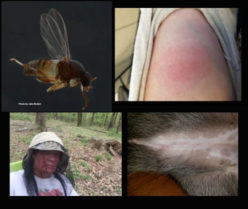
Is Bti safe for humans and other living creatures, great and small?
Fortunately, Bti, the natural substance used for suppression, is just for insects that breed in water, not for us, butterflies, or bees. None of us wants any harmful chemicals added to the environment, especially anything that might be cancer-causing. The suppressant, Bti is specific only to the biological domain of insects. The products that it produces in an insect’s body has no similarity to allergens or toxins that occur in mammals. You can read more about this in research language at National Institutes of Health.
Research nowadays is into how Bti attacks other types of flies (Cold Spring Harbor Biology), and might have anti-cancer potential (Molecules).
Treatment of running water with the natural spore, Bti
Successful use of Bti for 30 years
“The heady success of the larvicide Bacillus thuringiensis israelensis (Bti) virtually shut down research on other biological control agents, which had reached its high-water mark by the 1980s. Bti has been used against black flies for more than 30 years, some populations receiving up to 14 treatments annually (Adler et al., 2004). …Mortality rates are often around 95% (Gray et al., 1996).”
Suppression of black fly in Pennsylvania
Pennsylvania suppresses black fly by means of back-pack spraying with 12AS (Ventobac). The program requires 2 biologists (state personnel) to spray as a team, every other week or so. Some of these streams are in the list of streams that Pennsylvania treats every year. The spray costs $50 per gallon, and so each year may require many gallons in addition to the costs of personnel.
Suppression of black-fly in South Carolina
“A localized suppression program was initiated during the late summer of 1994 and continued through the fall of 1995. Four larvicide applications were conducted in 1994 and 11 in 1995, using the biological insecticide Vectobac. Larval mortalities of 94.5 and 97% were produced during 1994 and 1995, respectively. Adult black fly populations were reduced 92 and 88% during 1994 and 1995, respectively, from pre-program populations.”
Gray, E.W., Adler, P.H., Noblet, R., 1996. Economic impact of black flies (Diptera: Simuliidae) in South Carolina and development of a localized suppression program. J. Am. Mosq. Control Assoc. 12, 676–6 (For more information, click here.)